Nine experiments with light, each with a quick check and a notebook.
- CLASS 6 · LIGHT IN STRAIGHT LINES
Shadows and the pinhole camera
Why is the picture inside a pinhole camera upside down? Light travels in straight lines. An opaque object blocks it and leaves a shadow. A small light makes a sharp shadow; a wide light makes a dark core, the umbra, with a fuzzy edge, the penumbra. In a pinhole camera, light from the top of an object travels in a straight line through the hole to the bottom of the screen, so the picture is upside down.
- CLASS 7 · REFLECTION
Mirror, mirror
If you shine a laser at a mirror at 30°, where does it go? When light bounces off a smooth mirror, the angle of reflection equals the angle of incidence. Both are measured from the normal, the line at right angles to the mirror. The incident ray, the reflected ray and the normal all lie in the same flat plane.
- CLASS 7 · 10 · CONCAVE AND CONVEX MIRRORS
Curved mirrors
Can a mirror make an upside-down picture? A concave mirror curves inwards and brings parallel rays together at its focus, F. Move an object from far away towards F and its real, upside-down image grows and moves outwards; inside F the image becomes upright, magnified and virtual. A convex mirror curves outwards: it always gives a small, upright, virtual image but shows a wide view. Mirror formula: 1/v + 1/u = 1/f.
- CLASS 8 · 10 · REFRACTION
Bending light
Why does a pencil look broken in a glass of water? Light slows down in water and glass. When it crosses into a denser medium at an angle it bends towards the normal; coming out it bends away. Snell's law links the angles: n₁ sin i = n₂ sin r, where n is the refractive index (air 1, water 1.33, glass 1.5). Light leaving a rectangular glass block comes out parallel to how it went in, but shifted sideways.
- CLASS 10 · TOTAL INTERNAL REFLECTION
Trapped light
Can light bounce inside glass without a mirror? Going from glass into air, light bends away from the normal. At the critical angle (about 42° for glass, 49° for water) the outgoing ray skims along the surface. Beyond it, no light escapes: all of it reflects back inside. This is total internal reflection. Optical fibres use it to carry light, and the internet, around bends for thousands of kilometres.
- CLASS 7 · 10 · CONVEX AND CONCAVE LENSES
Lenses
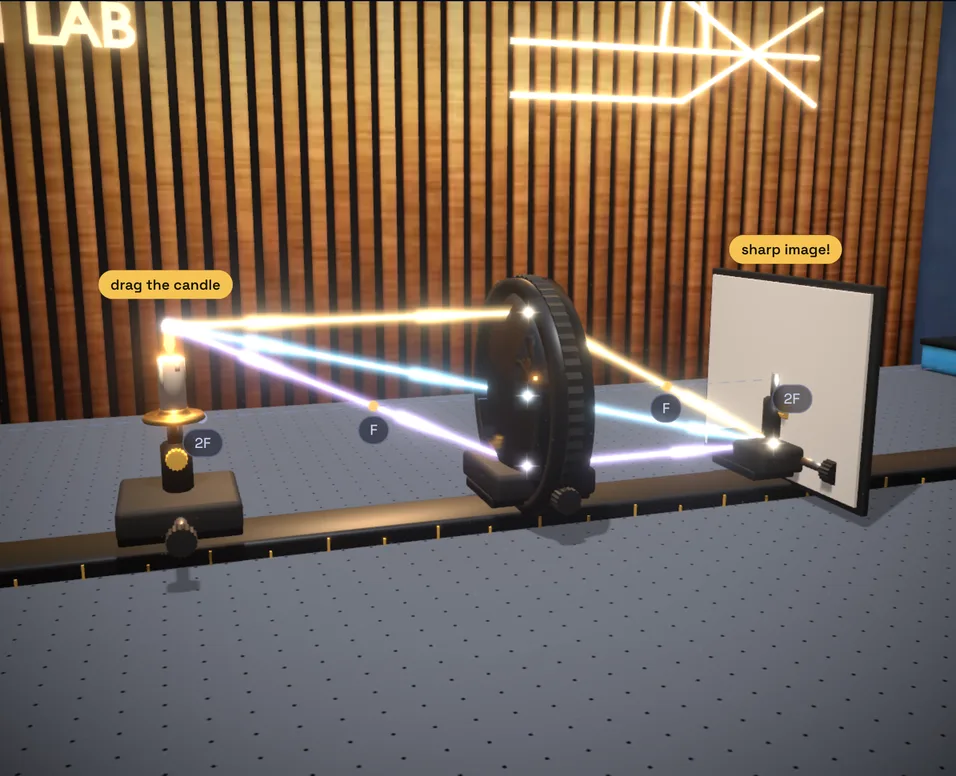
Where must the screen go to see a sharp image of the candle? A convex lens is thicker in the middle and brings light together; a concave lens is thinner in the middle and spreads it out. A convex lens forms a real, upside-down image on a screen when the object is beyond its focus, and an upright, magnified virtual image when the object is inside the focus, which is how a magnifying glass works. Lens formula: 1/v − 1/u = 1/f; magnification m = v/u.
- CLASS 7 · 10 · DISPERSION
Prism and rainbow
Where do the colours of a rainbow come from? A prism bends each colour by a slightly different amount because glass slows violet light more than red. White light spreads into a spectrum: violet, indigo, blue, green, yellow, orange, red (VIBGYOR). A second prism turned upside down brings the colours back together into white light, which shows the colours were in the white light all along, as Newton found.
- CLASS 10 · THE EYE
The human eye
How does your eye focus on near and far things? Light enters through the cornea, passes the pupil and is focused by the eye lens onto the retina. Ciliary muscles change the lens shape: thinner for far objects, fatter for near ones. This is accommodation. In short sight (myopia) far objects focus in front of the retina; a concave lens fixes it. In long sight (hypermetropia) near objects focus behind the retina; a convex lens fixes it.
- CLASS 10 · SCATTERING
Why is the sky blue?
Why is the sky blue at noon but red at sunset? Air molecules are much smaller than the wavelength of light and scatter short wavelengths far more than long ones: blue is scattered about five times more than red. Scattered blue light reaches your eyes from every direction, so the sky looks blue. At sunrise and sunset sunlight crosses much more air, so most of the blue is scattered away before it reaches you and the Sun looks orange-red.