Eight planets, their moons, a belt of asteroids and icy dwarf planets all circle one ordinary star, the Sun. The four inner planets are small and rocky; the four outer ones are giants made mostly of gas and ice.
- ROCKY PLANET
Mercury
The smallest planet, closest to the Sun. Mercury races round the Sun in just 88 days. With almost no air to hold heat, its sunny side bakes while its night side freezes.
Width 4,880 km · Year 88 days · Moons: None
- ROCKY PLANET
Venus
Earth's cloudy twin, and the hottest planet. Venus is almost the same size as Earth, but its thick air makes a runaway greenhouse. The ground is hot enough to melt lead.
Width 12,104 km · Year 224.7 days · Moons: None
- ROCKY PLANET
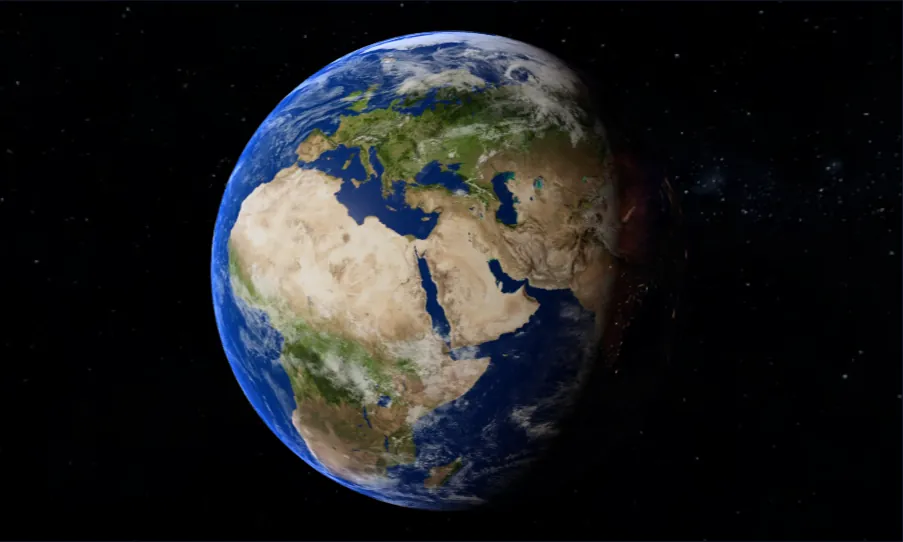
Earth
Our home: the only world known to have life. Earth sits at just the right distance for liquid water on its surface. Its air, oceans and moving crust make it the only place we know with life.
Width 12,742 km · Year 365.25 days · Moons: 1, the Moon
- MOON
The Moon
Our only natural satellite, 384,400 km away. The Moon keeps the same face towards Earth because it spins once for every orbit. Its dark patches are old lava plains; the bright areas are cratered highlands.
Width 3,474 km · Year 27.3 days · Moons: It is a moon itself
- ROCKY PLANET
Mars
The red planet, with the tallest volcano we know. Mars is a cold desert world coloured red by iron oxide, which is rust. Dry river valleys and old lake beds show that water once flowed here.
Width 6,780 km · Year 687 days · Moons: 2, Phobos and Deimos
- ASTEROID BELT
Asteroid belt
Leftover rocks between Mars and Jupiter. The asteroid belt is a wide ring of rocky and metal leftovers from when the planets formed. Jupiter's strong gravity stopped them from ever joining into a planet.
Width 940 km (Ceres) · Year 4.6 years · Moons: Some asteroids have their own small moons
- GAS GIANT
Jupiter
The biggest planet: more than 1,300 Earths would fit inside. Jupiter is a giant ball of gas with no solid ground to stand on. It spins so fast that a day lasts under 10 hours, which stretches its clouds into coloured bands.
Width 1,39,822 km · Year 11.9 years · Moons: More than 90 known
- GAS GIANT
Saturn
The ringed planet, light enough to float in water. Saturn's rings are made of countless pieces of water ice, from grains of dust to chunks as big as a house. They are huge but very thin.
Width 1,16,464 km · Year 29.5 years · Moons: More than 270 known
- ICE GIANT
Uranus
The tilted giant that rolls around the Sun on its side. Uranus is tipped right over, so it rolls round the Sun on its side. Each pole gets about 42 years of daylight and then 42 years of darkness.
Width 50,724 km · Year 84.0 years · Moons: 28 known
- ICE GIANT
Neptune
The windiest planet, found with mathematics. Neptune's winds are the fastest in the Solar System, over 2,000 km/h. It was predicted with mathematics before anyone saw it through a telescope.
Width 49,244 km · Year 164.8 years · Moons: 16 known
- DWARF PLANET
Pluto
A small icy world with a giant heart. Pluto is smaller than our Moon. In 2015 the New Horizons spacecraft found mountains of water ice and a huge heart-shaped plain of frozen nitrogen.
Width 2,376 km · Year 247.9 years · Moons: 5, the biggest is Charon